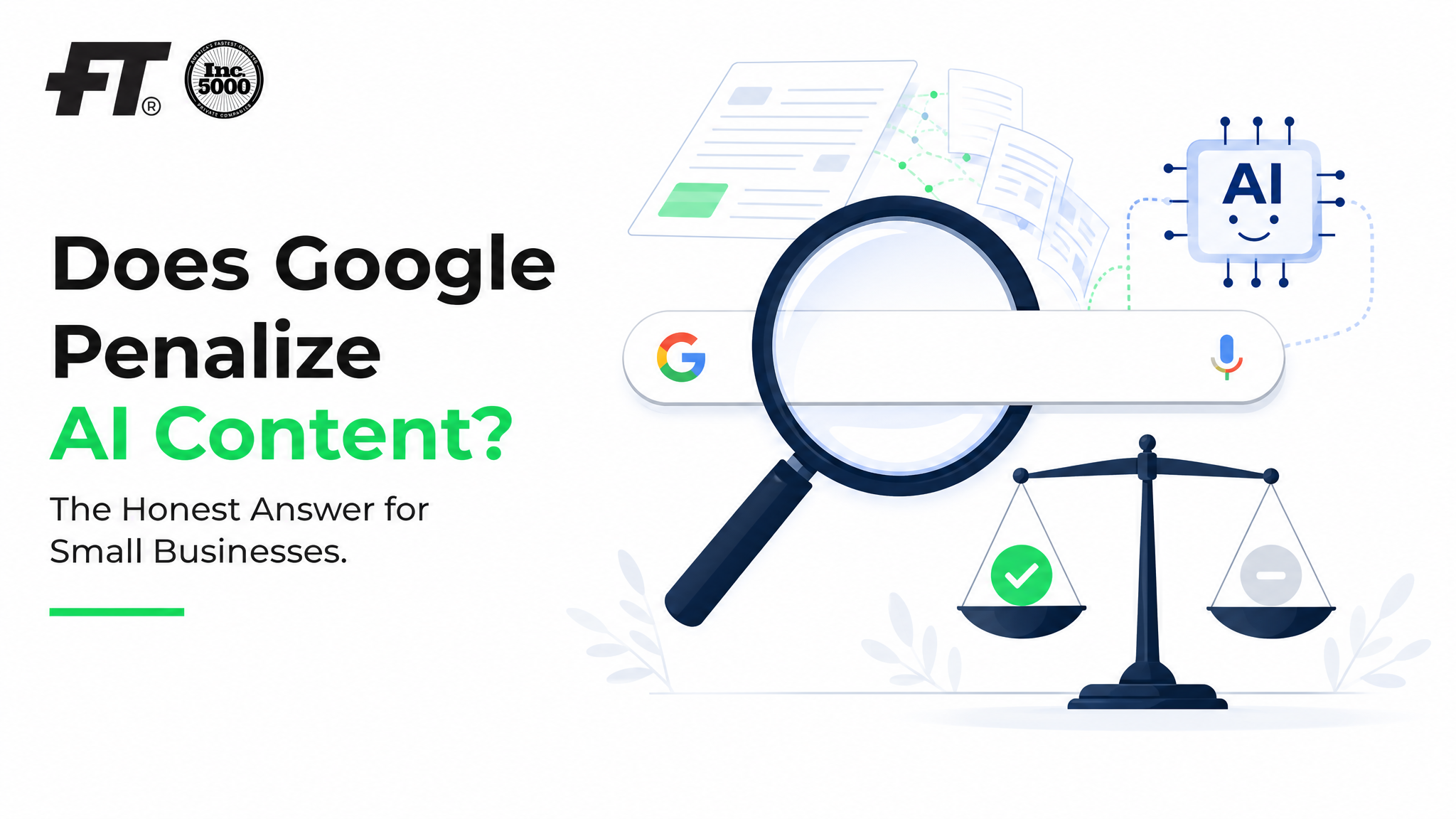
Does Google Penalize AI Content? The Honest Answer for Small Businesses
You finally found a faster way to keep your blog active: AI. Then the worry hits. Does Google penalize AI content, or are you about to tank rankings you spent years earning? It is a fair question, and the answer affects your leads directly. The short version is reassuring, but there is a catch worth understanding first. Our SEO team hears this one almost weekly.
Does Google Penalize AI Content? Not for Being AI
Here is the plain truth. Google does not penalize AI content just because a machine helped write it. In its official guidance, Google says using AI gives content no special advantage; it gets judged like anything else, on whether it is useful and original. Google’s own Search Central guidance on AI content has said this for years. What matters is people-first value, not the tool behind the keyboard. Write for readers. That principle has not changed, and it is not going to.
Where AI Content Actually Gets You in Trouble
The risk is not the tool. It is the temptation to mass-produce. Google’s spam policies target thin, repetitive pages cranked out mainly to game rankings, no matter what wrote them. That policy is called scaled content abuse, and it applies to people and machines equally. In May 2026, Google confirmed those spam rules now cover AI Overviews and AI Mode as well, as Search Engine Land reported. So publishing fifty hollow posts a week is the real danger. The AI is not.
The Myth That AI Content Ranks Higher
Let me push back on a popular claim. Some folks believe AI content ranks higher than human writing by default. The data says otherwise. One 2026 study of 42,000 blog pages found the top result was roughly eight times more likely to be human-written, and purely AI pages took the number one spot only about nine percent of the time. AI can absolutely rank. It just gets no head start for being AI. Quality still picks the winner.
How to Use AI and Still Win
So use AI. Just do not hand it the whole job. Draft with AI, then add what a machine cannot: real experience, accurate numbers, and a point of view your customers trust. Fact-check every claim, especially anything touching money or health. This experience-and-expertise standard, often shortened to E-E-A-T, is exactly what Google rewards. It is also why our GEO and AI-search work pairs smart tools with human editors. Clients who work this way see steadier organic growth, not penalties.
What This Means for Your Business
Here is the takeaway for a busy owner. AI is a helper, not a shortcut around quality. The businesses that win treat it like a sharp intern: fast and handy, but supervised by someone who knows the trade. Our clients average 20 to 50 new customer opportunities a month, and that comes from content built for real buyers, not for a word counter. The formula is simple. Blend AI speed with human judgment, and let genuine expertise lead the way.
Frequently Asked Questions
Q: Will Google know my blog was written with AI? A: Possibly, but that alone will not hurt you. Google’s systems look for spam patterns and low value, not the writing tool you used. Keep the content genuinely helpful and you are fine.
Q: Do I need to disclose that I used AI? A: Google suggests author bylines and disclosure when a reader would reasonably wonder how something was made. For most service-business blogs, a clear human byline and accurate information cover you well.
Q: How do I keep AI content from hurting my rankings? A: Edit it. Add first-hand experience, check the facts, and skip the mass-produced filler. One strong post beats ten thin ones every single time.
Ready to Make Your Content Work Harder?
So, does Google penalize AI content? No, but it rewards quality, and thin AI filler will quietly sink. If you want blog content that ranks and actually brings in calls, we can help you build it the right way. Call us at (888) 468-8785 or request your free strategy consultation. No pressure, just a clear plan for turning traffic into customers.