Marketing for HVAC Companies: A Complete Playbook for 2026
Most HVAC marketing advice on the internet was written by people who don’t market HVAC companies. It’s full of generic tips that apply equally to a yoga studio and a sheet metal shop, and it ignores the things that actually matter when you’re running a $500K–$2M HVAC business: your phone needs to ring, the calls need to be from people who can pay, and your slow shoulder seasons need to stay full.
This playbook is different. It’s the same blueprint we run for HVAC clients across the country — built over 25 years of working with local service businesses and refined against what actually produces tracked, booked jobs in 2026.
If your goal is 20 to 50 new customer opportunities a month from your marketing — which is the standard range we hit with HVAC clients across most major metros — this is the document to bookmark, share with your team, and refer back to when you’re planning the year.
1. The HVAC Buyer Journey in 2026
Every dollar you spend on marketing should map to a moment in the HVAC buyer’s journey. There are three of them, and they each demand a different play.
The emergency moment. The system died. It’s 97 degrees. They’re typing “AC repair near me” into their phone right now. They will call the first three contractors who show up, and they’ll book whoever picks up first and quotes a reasonable diagnostic fee. You win this moment with local SEO, Google Business Profile rankings, and Google Ads — and lose it instantly if your phone goes to voicemail.
The replacement decision. Their unit is 14 years old, it’s making a noise, and they know they have 6–18 months to make a $6,000–$15,000 decision. They’re going to research three or four companies, read 40 or 50 reviews, look at financing options, and probably get two quotes. You win this moment with reviews, a strong website, smart retargeting, and content that positions you as the trustworthy option.
The maintenance opportunity. They have a working system but they keep getting reminded — by their utility bill, by HVAC content on Facebook, by a doorhanger from a competitor — that they should probably get it tuned up. You win this moment with Facebook ads, email reactivation campaigns to past customers, and a maintenance plan offer that’s easy to say yes to.
Owners who only invest in the first moment (emergency calls) are stuck in a feast-or-famine cycle. Owners who invest in all three moments build predictable revenue across the year — including the shoulder seasons that kill most HVAC P&Ls.
2. Local SEO Foundations for HVAC
Local SEO is the single highest-ROI channel for most HVAC companies, because most HVAC searches happen in the moment of need with strong local intent. If you’re not in the top three of the Google Map Pack for “AC repair [your city]” and “HVAC contractor [your city],” you’re invisible to most of your highest-value emergency searches.
The foundations that matter most:
- Google Business Profile optimization. Correct primary category (“HVAC Contractor”), 5–9 secondary categories, accurate service areas, weekly GBP posts, regular photo uploads, and an actively managed Q&A section.
- NAP consistency across directories. Your business name, address, and phone number need to match exactly across every major directory (Yelp, BBB, Angi, Nextdoor, Bing, Apple Maps, and the dozens of smaller ones Google checks). Inconsistent NAP is one of the most common ranking killers we see, and it’s invisible until you audit for it.
- Service-specific landing pages. Don’t just have a single “Services” page. Build dedicated pages for AC repair, heating repair, AC installation, heat pump installation, ductwork, indoor air quality, and maintenance plans — each one optimized for the search intent behind that service.
- City-specific pages for every major service area you cover. These can be templated, but the content must be genuinely localized — not just find-and-replace city names.
- Reviews on Google. Aim for 4–8 new reviews per month, every month, in perpetuity. Velocity and recency matter as much as total count.
Done correctly, the local SEO layer alone produces a steady stream of inbound calls with no ongoing ad spend — which is exactly the kind of compounding asset every HVAC owner should want to build.
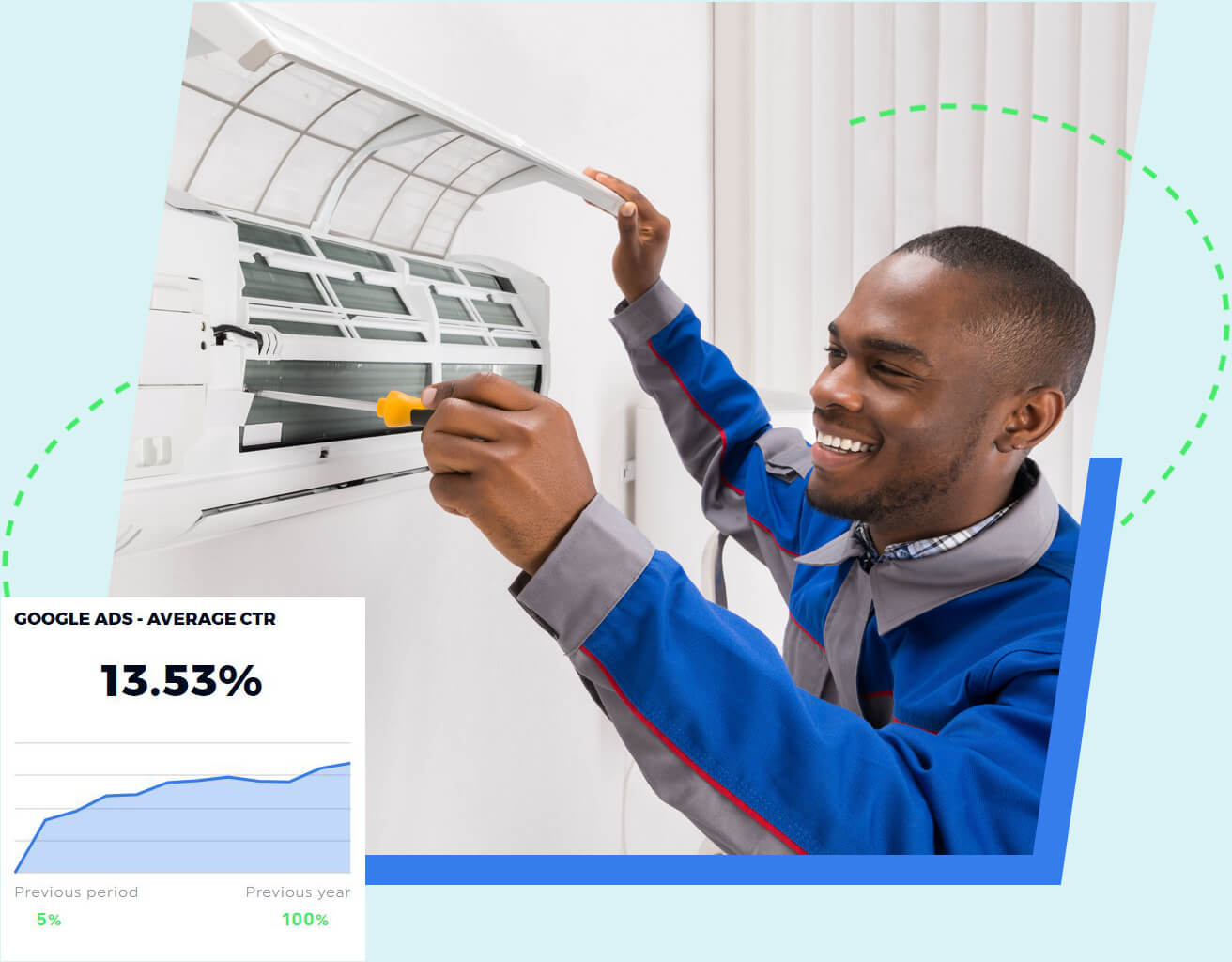
3. Google Ads That Convert at 10%+
The national average Google Ads conversion rate is 3.75%. Across our client base, we average 10%. That’s not a magic trick — it’s discipline applied to four specific levers.
Tight account structure. One ad group per service. AC repair gets its own ad group with its own ads, its own keywords, and its own landing page. Don’t lump “AC repair,” “AC installation,” and “duct cleaning” into a single catch-all campaign — the messaging mismatch alone will tank your conversion rate.
Aggressive negative keywords. Most HVAC accounts waste 20–40% of their budget on the wrong searches. DIY queries, job-seeker searches (“HVAC tech jobs near me”), and wrong-service queries all need to be excluded. We maintain a master HVAC negative keyword list that’s grown to several hundred terms, and we add to it every month based on what shows up in the search terms report.
Landing page match. If your ad says “24/7 emergency AC repair,” your landing page must say “24/7 emergency AC repair” above the fold — not “Welcome to Acme Heating & Air, your trusted local HVAC company since 1987.” Pediatrix, a medical client of ours, saw a 417% increase in conversions after a mobile-first redesign that aligned ads to landing pages. The same principle applies in HVAC.
Real conversion tracking. Phone calls (with call tracking), form submissions, and chat interactions — all tagged separately, all tied back to the keyword that produced them. Without this, you’re optimizing on guesswork. With it, you can spot which keywords produce booked jobs and which produce tire-kickers, and reallocate budget accordingly.
Hit those four levers and a 10% conversion rate stops being aspirational and starts being the floor.
4. Facebook Ads for HVAC (Yes, Really)
Most HVAC owners have either never run Facebook ads or have run them once, lost money, and sworn them off. Both are mistakes — but the second one is more common, and it’s worth understanding why.
Facebook ads don’t work for HVAC the same way Google ads do. Google captures people in the moment of need; Facebook captures them *before* the moment of need. That changes everything about how you build the campaign.
What works on Facebook for HVAC:
- Maintenance plan offers targeted at homeowners in your service area, ages 35–65, who own their homes. ($79 tune-up offers consistently outperform “free estimate” offers because they have a clear price and a clear value.)
- Replacement-focused video ads for homeowners whose systems are likely 10+ years old, showing what an installation actually looks like and demystifying the process.
- Retargeting for visitors to your website who didn’t convert. The 95% who left your site without calling are the highest-ROI Facebook audience you have.
- Seasonal urgency campaigns in late spring (before AC season) and early fall (before heating season).
Across our paid social campaigns, we average a 2x click-through rate compared to the national average — because the targeting is tight and the creative speaks specifically to the homeowner’s situation, not to “anyone who might need HVAC someday.”
5. Website Must-Haves
Your website is the conversion engine that everything else feeds. If it’s not built for conversion, you’ll spend more on ads to get the same number of jobs your competitors get for less.
Six elements every HVAC website needs:
- Phone number in the top right corner of every page, large enough to tap on mobile, clickable as a tel: link.
- Service-specific pages (see Local SEO above) — not just a single “Services” tab.
- A reviews bar above the fold showing your Google rating and review count, ideally with a quote rotation.
- An “About” section that establishes trust — years in business, license numbers, photos of the owner and crew, service area map.
- Mobile-first design. More than 70% of your traffic is mobile. If your site loads slowly or buttons are hard to tap, you’re leaking calls before they ever happen. Pediatrix’s 417% conversion increase came almost entirely from mobile-first redesign — the same lift is available to HVAC sites.
- Page speed under 3 seconds. Every additional second of load time costs you roughly 7% of conversions. Speed is a conversion lever, not a tech detail.
If your website is more than 3 years old and you haven’t touched it, it’s almost certainly costing you money. The question isn’t whether to update it — it’s whether to refresh or rebuild.
6. Reviews & Reputation
HVAC is a trust business. Most homeowners are inviting a stranger into their attic to make a $6,000 decision. Reviews are the single biggest factor in whether they call you or your competitor.
The reputation playbook for HVAC:
- Steady velocity, not bursts. 4–8 new reviews per month, every month, beats 50 reviews in one month and zero for the next six.
- Automate the ask. Tie a review request to your invoicing or job-completion process so it goes out within 24 hours of the job, when satisfaction is highest. (We integrate this with our clients’ CRMs as part of the standard retainer.)
- Respond to every review — positive and negative, within 48 hours. Owners who respond signal an active, professional business; silent profiles signal absentee ownership.
- Diversify beyond Google. Yelp still matters in some metros. Angi, BBB, and Nextdoor matter for trust signals even when they don’t drive direct traffic.
- Use reviews on your website — not just as a count, but as content. The actual words your customers use are some of the highest-converting copy on your site.
7. Tracking What Works
You can’t improve what you can’t measure, and most HVAC owners are flying blind on their marketing.
The minimum tracking stack:
- Call tracking on every marketing channel (we use CallRail), with separate numbers for Google Ads, GBP, Facebook, and your main website.
- Form tracking tied to source (UTM parameters and a CRM that captures them).
- Conversion-to-booked-job tracking — the most important metric in HVAC marketing. A “lead” isn’t useful unless you know how many of those leads actually became paying customers.
- Cost per booked job by channel. Cost per lead is vanity; cost per booked job is reality.
- A weekly dashboard the owner actually looks at. (We provide ours via the Fasturtle Dashboard), which consolidates Google Ads, GBP, Facebook, and call tracking into a single view.)
When you can see cost per booked job by channel — week over week, month over month — you can make budget decisions in 60 seconds that previously took 60 minutes of guessing.
8. The Annual HVAC Marketing Calendar
Marketing for HVAC isn’t flat across the year. The calendar matters.
January–February: Heat-related emergency demand is high. Lean into Google Ads on heating keywords. Push maintenance plans to past customers (email + Facebook retargeting) ahead of cooling season.
March–April: The transition window. Run Facebook campaigns for AC tune-up offers. This is the highest-leverage moment of the year because it builds the booked-job pipeline before cooling demand spikes.
May–August: Peak cooling demand. Maximize Google Ads spend, monitor capacity, and watch for bidding wars driving up cost per click. Local SEO and review velocity carry an outsized share of the load here.
September–October: Transition window. Push heating tune-ups before the first cold snap. Replacement campaigns work especially well here for homeowners who limped through summer with a struggling system.
November–December: Heating emergency demand picks up. Plan Q1 strategy and budget. This is also the smartest window to invest in long-cycle work like website rebuilds and content — when paid media is competitive but slower-loading SEO investments will pay off into next year.
Owners who run their marketing on this rhythm — instead of reacting to whatever just happened — book more jobs at higher margins across the year.
Talk to an HVAC Marketing Expert
This playbook is the framework. Applying it to your specific market, capacity, and competitive landscape is the work — and it’s the work we’ve spent 25 years getting good at.
If your phone isn’t ringing the way it should, if your ads dashboard looks active but the calls aren’t coming, or if you just want a second opinion from a team that markets HVAC companies for a living — we’d like to talk.
Talk to an HVAC Marketing Expert
Or call us directly: (888) 468-8785. The first conversation is free, useful, and pressure-free.
FAQs
How much should an HVAC company spend on marketing?
It depends on capacity and growth goals, but most healthy HVAC businesses in the $500K–$2M range invest 6–10% of revenue in marketing, weighted toward Google Ads and Local SEO. The right number is whatever produces 20–50 new customer opportunities per month at a cost per booked job that hits your margin target.
Are Local Service Ads (LSAs) worth it for HVAC?
Yes — but they’re a complement to Google Ads, not a replacement. LSAs can drive lower-cost leads but with less control over targeting and quality. Most HVAC clients we work with run both LSAs and standard Google Ads simultaneously.
How fast can I expect HVAC marketing to start producing leads?
Google Ads can start producing calls within 7–14 days. Local SEO typically takes 60–120 days to produce meaningful ranking lifts. Reviews and content compound over 6–12 months. Plan accordingly.
Should I do my HVAC marketing in-house or hire an agency?
If you have someone in-house who can dedicate 20+ hours a week and has deep paid-search expertise, in-house can work. For most $500K–$2M HVAC businesses, agency is more cost-effective because you get specialists across SEO, paid, and creative without paying full-time salaries for each.
What’s the single most important marketing metric for HVAC?
Cost per booked job, by channel. Everything else — impressions, clicks, leads, conversion rate — is in service of that one number.